
Clinical Insight Series - Part III
Recognising the Signs of Burnout: Listening Before the Body Shouts
One of the greatest challenges with burnout is that it rarely announces itself dramatically.
More often, it arrives quietly.
It begins with subtle changes that are easily dismissed as being “busy,” “under pressure,” or simply “getting older.” Because these changes often develop gradually, many people adapt to them without realising how much their capacity for recovery has diminished.
Common Early Signs of Burnout
Some of the early signs may include:
- waking unrefreshed despite adequate time in bed,
- persistent physical or emotional exhaustion,
- difficulty concentrating or persistent “brain fog”,
- reduced creativity or motivation,
- disturbed sleep,
- increasing anxiety or irritability,
- emotional numbness,
- digestive changes,
- frequent headaches or muscular tension,
- relying increasingly on caffeine, alcohol, sugar, or constant activity simply to maintain performance,
- withdrawing from relationships,
- feeling disconnected from work, family, or oneself,
- losing the ability to experience genuine joy, curiosity, or presence.
Not everyone will experience all of these symptoms.
Some people notice only one or two.
Others recognise many.
The important point is this:
These symptoms are signals.
They are the body’s way of communicating that its capacity to regulate and recover may be under increasing strain.
Burnout Is Not the Same as Depression
Burnout is frequently confused with depression, anxiety, chronic fatigue, or other stress-related conditions.
While these experiences may overlap, they are not identical.
Depression can affect every aspect of life regardless of circumstance and requires careful medical assessment and appropriate treatment.
Burnout, as currently defined, is most closely associated with prolonged, unresolved stress and often develops gradually through sustained demands that exceed the individual’s capacity for recovery.
Similarly, persistent fatigue may have many possible causes, including endocrine disorders, nutritional deficiencies, sleep disorders, autoimmune disease, infection, medication effects, or other medical conditions.
For this reason, no one should assume that exhaustion automatically means burnout.
A thoughtful clinical assessment remains essential.
One of the most important responsibilities of healthcare is not simply recognising burnout, but recognising when something else may be contributing to a person’s symptoms.
Why There Is No Standard Burnout Recovery Programme
Perhaps the most important lesson I have learned throughout more than three decades of clinical practice is this:
No two experiences of burnout are the same.
The symptoms may appear similar.
The stories that created them rarely are.
One individual may have spent years leading a global organisation.
Another caring for an ageing parent.
Another navigating grief.
Another recovering from illness.
Another living through prolonged uncertainty.
Each arrives carrying a different story.
For this reason, meaningful recovery cannot begin with a standard protocol.
It begins with listening.
Listening to the person’s history.
Listening to their body.
Listening to what life has been asking of them for months—or perhaps years.
Only then can recovery become genuinely personalised.
Why We Developed the Burnout Recovery Journey
Over many years, one observation became increasingly clear.
People experiencing burnout rarely needed one treatment.
A massage alone was not enough.
Meditation alone was not enough.
Nutrition alone was not enough.
Exercise alone was not enough.
Each has an important place.
None is sufficient on its own.
This understanding gradually shaped the Burnout Recovery Journey at Sen Wellness Sanctuary.
It was not created as a wellness package.
It evolved through decades of clinical practice, caring for thousands of people, learning from colleagues across medicine and psychology, and remaining deeply curious about one enduring question:
What genuinely helps human beings recover?
The answer was never one therapy.
It was the thoughtful integration of many disciplines around one individual.
Today, our approach combines appropriate medical assessment with personalised Ayurveda, therapeutic bodywork, osteopathic principles, restorative movement, breathwork, meditation, nutrition, sleep restoration, time in nature, meaningful conversation, and the support of an experienced multidisciplinary team.
Each element contributes something valuable.
Together, they create the conditions that support the body’s own capacity for regulation and recovery.
Our intention is not to replace conventional medicine.
Rather, it is to complement it through a whole-person model of care that recognises the complexity of burnout and honours the individuality of every guest.
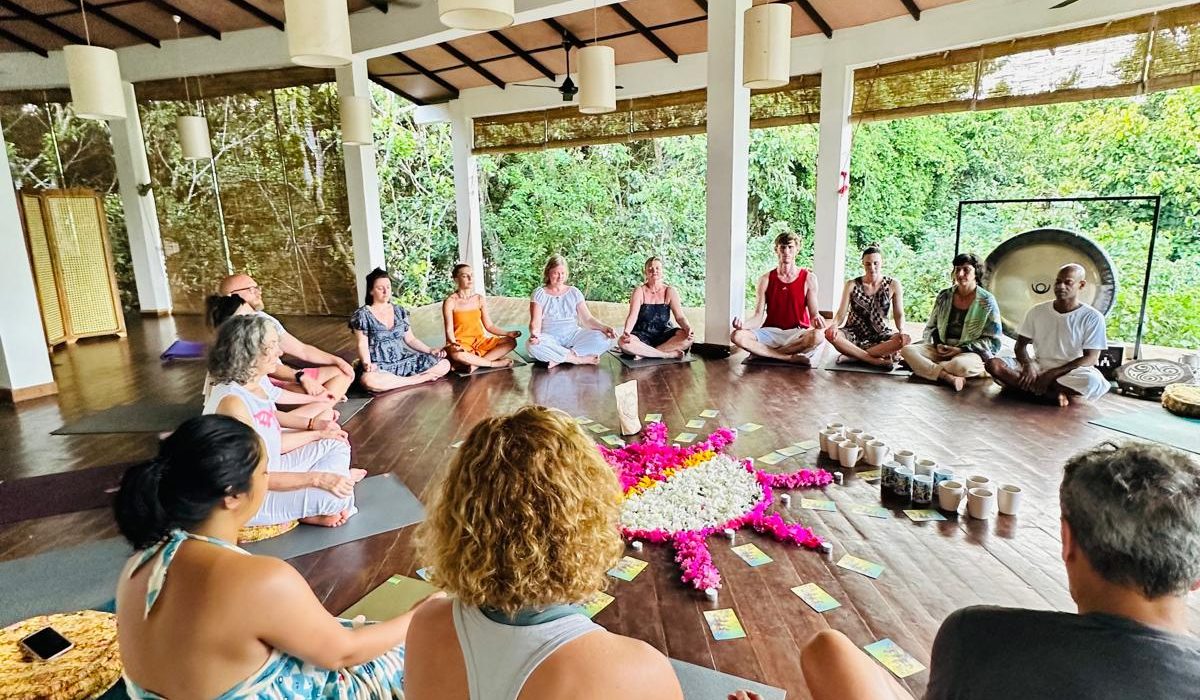
Why a Wellness Sanctuary Matters for Burnout Recovery
People often ask why someone experiencing burnout would travel to a sanctuary.
The answer is surprisingly simple.
Recovery requires conditions that modern life often struggles to provide.
Time. Stillness. Restorative sleep. Nutritious food. Nature. Silence. Gentle movement. Meaningful conversation. A supportive community. Space to think. Space to breathe. Space to reconnect.
A sanctuary is not simply a destination.
It is an environment intentionally created to reduce unnecessary demands while strengthening the biological and psychological conditions that support recovery.
Nature itself plays an important role.
Growing evidence suggests that time spent in natural environments can reduce physiological stress, improve mood, support attention, and encourage nervous system regulation.
For many people, simply slowing down within a carefully held environment becomes the beginning of remembering what health once felt like.
Looking Towards the Future of Burnout Care
Burnout is one of the defining stress-related health challenges of our time.
Our understanding continues to evolve.
Modern neuroscience, behavioural science, sleep medicine, psychophysiology, and systems biology are expanding our understanding of how chronic stress influences the whole person.
Equally, ancient healing traditions continue to remind us that recovery is not simply the removal of symptoms.
It is the restoration of balance.
At Sen Wellness Sanctuary, this meeting point between contemporary science and traditional wisdom continues to shape our work.
Alongside caring for our guests, we remain committed to careful clinical observation, collaboration with research partners, and contributing to the growing evidence surrounding whole-person approaches to recovery.
There is still much to learn.
Every guest teaches us something.
Every recovery deepens our understanding.
Every conversation reminds us that behind every diagnosis is a human story.
A Final Reflection on Burnout and Recovery
Burnout is not a personal failure.
More often, it is the body’s honest expression that it has been adapting for too long without sufficient opportunity to recover.
Recovery does not begin by pushing harder.
It begins by listening more deeply.
Listening to the body’s signals. Listening to the nervous system. Listening to the life we have created.
And gently asking what needs to change—not simply to return to where we were before burnout, but to create a healthier and more sustainable way of living.
Perhaps that is the deeper purpose of recovery.
Not merely to restore our ability to work.
But to restore our capacity to live well.
That is the clinical philosophy that continues to guide our work at Sen Wellness Sanctuary.
And it is the purpose of the Sen Wellness Healing Journal:
To explore, through science, clinical experience, and thoughtful inquiry, how human beings heal, recover, and flourish.
by Dr.sam kankanmge
